Showing posts with label history. Show all posts

Wednesday, August 15, 2012

Connecting Birthday and History ...

My birthday is today!
I was looking at Thinkfinity today and noticed the Today in History area ....
I wondered what happened in history on my birthday ... so I clicked on the calendar and went to find out!
That got me thinking about research for students in a class. Each student has a birthday, right? So perhaps for one research project/writing lesson, students would need to research something that happened in history on the day he or she was born. I had grand ideas of using those projects to create a class book or using the multimedia digital projects created to form a classroom gallery. Students could have a choice as to how to share the information collected. Students could investigate the findings of other students ....

So I started playing around with that idea ...
I have a coworker (Marty) who will celebrate his birthday on August 18 ... what happened in history on that day?
I started getting more and more excited about my idea and how rubrics could be formed to assess research and the creation of the projects. I started seeing wonderful creations in my mind. I started thinking of the other dates that are significant in my life that I could look at ...
Another coworker (Dorene) will celebrate her birthday on Sept. 7, so I went looking for the even in history from that day on the Thinkifinity calendar.  I clicked forward to September and found ..... 
the calendar was blank ....
My first thought was ... oh no, another idea down the drain ...  because it won't work
My next thought was ... it may not work exactly the way I had it planned out in my head originally but it still will work in some shape ...
So I started considering alternatives ...  

  • each person could look at events that happened in history on the day he or she was born by looking at it that day  (but what about the kids with Summer birthdays ... my sister's is in July and mine is in August)
  • students could look at the past Wonders of the day on Wonderopolis to find an event to research based on the information that was shared on their birthdays
  • we could look for other resources to use to explore dates in history
That was when I remembered that the Thinkfinity calendar gives you the option to look at days, week, months, and even years. I had seen the ability to see previous ones when looking at the day, week, or month calendars .... so I wondered if I might be able to look at the calendars from previous years ...
So I decided to try!
The good news is that YOU CAN! 
So for my coworker who will celebrate her birthday on Sept. 7, I looked at the calendar from last year to see what event was shared that day!
Yay!
You may have noticed that several of my pictures include a button to click to view more. When you click on that, you are taken to a page describing the event in 2-3 paragraphs. Along with that information, you can also find links to various lessons, activities, and ideas from the Thinkfinity Content Partners that go along with that topic or could be used with that type of information!
The other ideas that I brainstormed above would work too and I predict you can come up with some even better ways to use these dates in history!
I would love to hear some other ideas, so please leave a comment and share them!
Go pick a date and explore ....


Tuesday, April 17, 2012

Free Electronic Field Trip

Visit Colonial Williamsburg website where teachers and students can find out more information about colonial times. There are videos, podcasts, blogs, etc. Find out if Thomas Jefferson's ideas about education are still valid today by viewing his blog. Read recipes from the colonial era at "History is Served". There is also a Kids Zone with games and activities. There are many more activities for teachers and students to find at Colonial Williamsburg.

Last year, Colonial Williamsburg offered a free electronic field trip to teachers. They are offering another free electronic field trip for September 1 - 30, 2012 (next school year), just in time for election year. It is called "The Will of the People". Teachers can register for this field trip now and plan for next fall. The field trip has information about the negative campaigns from Thomas Jefferson's time. I think that this field trip would fit in well with our upcoming election. When was the last time (if ever) that we have not heard our candidates spreading negative campaign messages? By registering, teachers will be able to view streaming videos, lesson plans, online activities, and a teacher guide.

This electronic field trip fit very nicely into our TPACK (Technology, Pedagogy, and Content Knowledge) model that we are using. A previous blog post on TPACK can be found here. In the Social Studies Activity Types, there is a section on "Experience a Field Trip". This also ties into the Information and Technology Essential Standards (ITES) of Access and Gather Information. As I scrolled down our Social Studies Activity Types, I also found several other activities that "The Will of the People" will fit into. For example "Sequence Information" which meets the Organize Information standard for ITES; or,"Discuss" which meets Organize Information and communicate Information. There are a lot more activity types that this electronic field trip will go with also. ITES for K-5 can be found here; 6-8 here; and 9-12 here.

Why not check out the Colonial Williamsburg website and register for "The Will of the People" free electronic field trip. I think it will be very interesting.

Image: 'Jefferson? Williamsburg' http://www.flickr.com/photos/67958110@N00/4665575366

Wednesday, March 28, 2012

Election Season is Quickly Approaching

Election Season is quickly approaching and this season promises to be another scorcher!  You can sense it in the air and on TV.  One politician is going to save the world while sharing that their opponent is ready to destroy the world.  Yes it appears this is going to be a hot one that's expected to last until at least November.


Elections and politics can be an overwhelming and difficult subject to follow but luckily there are teachers out there to help us make sense of it all.  I was at West Forsyth High School a teacher shared with me many of her go to websites to help students find the truths behind politics and the political arena.

Below are her websites with a brief explanation of what they might be used for.


Often times people can tell a lot about a politician by the support they receive in election season. 
http://www.opensecrets.org/ is a great website that lets you explore who is funding the presidential and congressional candidates.  This website will be a great resource for students to back their arguments and leads to great discussion on how candidates vote while in office.  This website has data on fundraising amounts by candidates as well as their largest PAC supporters.

Many promises are made in election season.  One of my favorite websites is http://www.politifact.com/ .  Politifacts is a website that helps citizens follow a politician or idea (i.e. healthcare) and find the truths behind the claims made and the reality of those claims.  Politifacts is chocked full of information to help your students discern between what political ads claim and what is really happening.


During election season students may wonder where they stand compared to other Americans on certain issues.  Polls are a great way to determine this.  http://www.pollingreport.com/ is a great website that collects many polls and puts them on one website.  Polls from CNN, AP, Wall Street Journal and the PEW Research Center are just a few that this collection has to offer.  The homepage offers polls anywhere from the President and Congress to National Security and Issues that are recently trending. 
Three other local websites that would be of interest is the NC Democratic Party's website http://www.ncdp.org/ the NC Republican Party's website  www.ncgop.org/ and the Forsyth County Board of Elections website www.co.forsyth.nc.us/Elections/  

With the political season on the horizon I hope these websites offer a few tools to help you weather the storm.


Monday, March 12, 2012

Tweeting to Disaster

I, to make a bad joke, ran across this article this morning about the upcoming 100th Anniversary of the sinking of the Titanic.  The History Press has launched a new Twitter account to chronicle the days leading up to and including the faithful night that the UN-Sinkable ship sank in the waters of the North Atlantic.

You can follow the timeline through the hashtag #TitanicVoyage (@titanicrealtime), and even from some of the people that were a part of the launch like #crew, #engineering, #captain to hear their thought and accounts of the events that led up to that now infamous night of April 15, 1912. Currently the timeline was setup on March 10, 2012 to begin the chronicling of the events.  There are just a few tweets out there now from the captain, crew, engineering and officer but as the time gets closer to the launch date we should start seeing the timeline fill up.  Currently there are almost 13k followers of the site.

This could be a great lesson starter for you Social Studies classes where the students can follow along with the feed as things are happening to see what it would have been like if Twitter was around during that time for people to be able to send out updates as they were happening.  We find it so often now with other natural disasters that we are getting updates from Tweets faster than we can get news crews into areas.  It will be very interesting to see how things unfold through tweets over the next month.  Maybe to see if there will be tweets coming from what would be passengers as well as the crew for their thoughts on what will, or rather has happened.

** Update **
I just got some new information that I needed to add to this post.  The information that is being Tweeted out is, and will be coming directly from the ships log books.

Monday, March 5, 2012

What are you learning about this month?

Moving Day In March, one of the themes is Women's History Month. I came across this while looking at Thinkfinity today:


The theme for the 2012 Women’s History Month is Women's Education - Women's Empowerment. This month-long event celebrates the fight against cultural and historical prejudices that traditionally created the gender gap in schools, institutes of higher education, and professions. Thinkfinity and its Content Partners have a variety of lessons and resources that showcase the contributions of women to our society and culture.

Here are a few of the resources shared on Women's History Month page:

Who Was the Most Famous Female Aviator?
View a video about aviation and find out more about Amelia Earhart with this Wonder Of the Day. Then try one of the follow-up activities to explore the topic in more depth. (from Wonderopolis)


Great Women of Our Pasts
Consider the sacrifices made and obstacles overcome by women who shaped our past from 1754 to the present. Review a list of featured books on this topic and learn how a genealogical study can provide valuable insights into the people and events in your family’s past


Females in the Spotlight: Strong Characters in Picture Books
Identify the character traits demonstrated by strong female protagonists in several books, and use the online Character Trading Cards tool to create and share your own trading card.

Young Women in Science: Forging New Pathways
This booklet, designed to inspire young people to consider science as a career, provides a glimpse into the lives of young female scientists from a variety of backgrounds.

Analyzing Character Development in Three Short Stories About Women
Compare the women characters in stories written in different historical times to analyze the effects of gender differences and society’s expectations on the role of women.

Taking Control of Their Lives
Follow the stories of two women from different countries and different generations who improved their literacy skills and became involved in an important health empowerment project that had a personal impact on their own lives  

Wednesday, February 1, 2012

Are you ready to jump back in time?

Have you seen the Caleb's Creek Media Matters blog?  That is one place that Holly DuBois shares interesting resources as well as book activities she plans to use.

Looking at her blog one day, I came across a resource that I had not heard about before .... so I thought I would share the information with you too!

Here is a part of the blog post Jump Back in Time:

Using the America's Story section of the Library of Congress resource, you can click into the Jump Back in Time feature. (I have talked about other parts of America's Story before here and here if you are interested and missed them.) Using the Jump Back in Time feature, there are a lot of neat things you can do. Of course, the main part included links to all the major historical eras of the United States, broken down into sections from 1492 to present day. Each era link will take you to information along with many links to other stories related to the same time period. I like the way this is done because you can see history as a string of many stories that fit together rather than a bland history book paragraph listing the things that happened.

Super Sleuth game
There is also a Fact or Myth question when you are on the main page with a different question each time you visit the page. It explains why it is a fact or myth. You can also choose a date to visit to see important things from that day. It suggests using your birthday, but this could also be fun to do each day to see what happened that day. You could also do the Fact or Myth question and use both as an opener to the day or something for those last few minutes after you pack up at the end of the day. The Super Sleuth game is fun but short. Famous photos of historical people have had something added to them that doesn't fit the time period and students have to find it.

This is a great place to start with introducing a time period, giving context to an era a book might be set in, or just for the history buffs!


I can see some great Social Studies and History connections for this resource from the Library of Congress. This would probably be a good place to find some nonfiction reading material.

I encourage you to look at Caleb's Creek Media Matters ....

We enjoy highlighting posts and/or blogs in the Winston-Salem/Forsyth County School System .... if you have any to share, just let us know!

We also like to share where we learned new things, so the next time you learn something new and/or interesting, let us know and hopefully we can share it too!

Wednesday, November 30, 2011

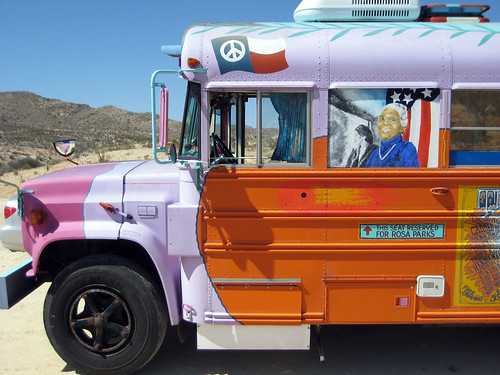
Hop on the Bus with Rosa Parks!

Peace bus in the desert.

Do you know why we celebrate Rosa Parks on December 1? Do your students?

Rosa Parks was not born on December 1, but she did something on December 1 for which she is remembered.

If you need any ideas for things to use in the classroom, check out the available resources from these instructional sites:

Here are some resources I found from searching in Thinkfinity:

Here are some videos from Learn360:
Here are some resources I found from searching in netTrekker:

Tuesday, November 8, 2011

A New Take on History

If you are a fourth grade teacher and have not been to the North Carolina History Project web page you might just be missing out on some new and interesting facts about North Carolina.  You might be asking how can this site benefit me?  Here is how they describe it. "... an edited, evolving, and free online encyclopedia of North Carolina that also includes commentaries, lesson plans, and a community calendar."

To me the site offers a lot about North Carolina that has been broken down into multiple categories and listing so that it makes it easier on the researcher to locate topics for discussion, reports, conversations an other information.

The site homepage is laid out well to offer the visitor a quick glance at what is available but to also provide the most amount of searching power in a few short clicks.  On the website you have scrolling image set of people, places and things inherent to North Carolina that you can click on and read more information about.  Across the top of the page you have an alphabetical list so you can perform a broad topic search just like an Encyclopedia by just clicking on the letter you want.  There is a Featured entry of the day section in the bottom middle of the page that offers you a one click link to read more information about the topic.  You can also browse through the Category dropdown menu on the right side of the page to filter information about specific topics.  Categories like Colonial North Carolina, Places, Document, etc.  Then in the bottom right corner of the page lists out the latest information that has been added to the site.  So far in just a few days of researching the site I have been able to find lots of information quickly and easily through the different search options available on the site

The North Carolina History Project site is funded by the John Locke Foundation and they are currently offering a Citizens' Constitutional Workshop from the link on the left banner.  This link takes you off of the site to the John Locke Foundation website for further information.

There is a separate Educators Corner on the site that offers some research and lesson plan information that has been shared with the site through user created content.  Currently there are not many user lesson plans available but there is a call to share on the site where if you create lesson plans from the content on the site you can share it with them and they will review and post the information for others to use.

If you are teaching North Carolina History whether in Elementary or Middle School this is a site that you just might want to add to your resource list not only for your use but for your students as well.

Thursday, August 11, 2011

Learning About Government Can Be Fun!

At a workshop this summer, a teacher was creating a lesson for her students talking about the different areas of government. A couple of days later, EDSITEment posted a lesson plan with the title of "Balancing Three Branches at Once: Our System of Checks and Balances. This gave me an idea for a blog post. I decided to find some other lessons about Civics and Government and put them into a Glog. I have written about Glogster EDU quite a few times before, but find it a great way to "posterize" lesson plans to share with others. Below is my Glog on the Three Branches of Government.


Some more websites are listed below:

Ben's Guide to U.S. Government for Kids (K-12) You choose the grade level.
SAS Curriculum Pathways (6-12)
My Social Studies Diigo Links


Hope you enjoy these lesson ideas and web sites!

Sunday, June 6, 2010

NC History ... a digital version?

One of my favorite parts of teaching 4th grade in North Carolina was teaching about the state of NC in Social Studies. What better place to learn about than right where you live? I find the geography, history, and features of NC very interesting, so it was fun for me to teach about it. One of my favorite parts of NC history to teach about includes information about The Lost Colony of Roanoke.
I tried to go beyond the information in the basic textbook when teaching Social Studies When I searched for information about The Lost Colony to share in my 4th grade Social Studies class, I remember struggling to find good information online that was useful for 4th grade.
I have been looking at the
NC History Digital Textbook on LearnNC, and I think I have found a solution to that problem. Although this digital textbook is geared more for secondary students, I think portions of the information can be used with elementary students, especially the images and maps. I also used the Social Studies text as a way to teach many reading skills, especially ones needed for finding and comprehending information in the non-fiction genre. Learning reading skills while investigating history made sense. Information about The Lost Colony is located in the Pre-Colonial (to 1600) section of this digital textbook.
The story of the Lost Colony is a mystery ... still unsolved today. Presenting it that way makes it much more interesting for students (and it really is an unsolved mystery). I think the background and the basic facts of the story can be presented using information from The Lost Colony: A silent "cittie" (this section is towards the bottom of the page). Since the reading level is higher than elementary, this would not be a good section to assign for student independent reading. I see lots of places to stop and ask questions to check for understanding and to provide clues on strategies to use to read nonfiction and informational text (something like the Directed Reading-Thinking Activity strategy could be used). The words that are linked to definitions could also provide good practice for students in using context clues to determine unknown words.
Located near the top of that webpage in is an illustration which could be used at the beginning of the class or lesson to possibly get students predicting what the lesson could be about. Another idea is to use it more towards the end of the lesson for students to use the information learned to create a conversation the two figures could be having. I think using visuals to promote student thinking is a great way to engage students and increase learning.
The next part of the story, The Search for the Lost Colony is one that students particularly enjoy since it is a mystery. The first paragraph on this page provides a great introduction to learning about what possibly happened to these colonists. After reading that paragraph to students, I can see having a good discussion about the information we get from different sources. The three ideas presented here (The Lumbee, A Young Mayde in the Chesapeake, and Two Factions) could be good for a class discussion or project.
Some problem-based or project-based learning could be incorporated to provide a better understanding of what students have learned. The information and links in the Learn More section in the sidebar could be used as things for groups of students to look at and report back to the class. Those areas could also be used for differentiation or for "early finishers" to look at. The related topics that are also listed in the sidebar could be good research or project topics for this lesson. This lesson could be connected with writing by encouraging the students to write about what they think happened to the lost colonists, or another LearnNC idea could be used to encourage the writing of a mystery.
These are just a few ways I came up to be able to use this 8th grade digital textbook for 4th grade. I wonder what else might be possible ....
Here is another post I did on this great resource from LearnNC.

Thursday, May 27, 2010

Antiques Roadshow – In the Classroom?

Alright, let me say… very excited about this post. I love, love, LOVE the Antiques Roadshow. Not for the reasons you might guess of instant riches. But, instead… I love to hear about the history of each and every piece – and how the folks featured happened to have a connection to its history.

So – how does this make ANY sort of sensible connection to your classroom? Glad you asked! Think about it like this - Short history lessons can be invaluable for your students!

Straight from the Antique Roadshow’s website…. “If you are looking for new ways to get your students excited and engaged in history, geography, the arts and society, and a range of other topics, you've come to the right place. Integrate the study of material culture (artifacts and objects) into your teaching, using objects appraised on ANTIQUES ROADSHOW. Through questions, activities, and other resources, students take a closer look at the "things" people have used throughout history to create history…”

Don’t have a clue what TV show this is? See for yourself… Watch this short appraisal video clip referencing a Marine Chronometer, ca. 1815 (used for measuring longitude). History AND Math. Oh my!


http://www.pbs.org/wgbh/roadshow/archive/200906A50.html


Check out this Antiques Roadshow link just for teachers…


http://www.pbs.org/wgbh/roadshow/teachers.html


BTW, I am keeping my eyes and ears open for how HGTV’s “If these Walls Could Talk” makes its way into the classroom. History teachers… watch and wait with me. In case you couldn’t figure out my excitement – history is something I consider to be way cool. Want more history links/resources? Check out some of my previous posts.

Monday, April 12, 2010

North Carolina History ... a digital version

Having lived in NC most of my life and having taught 4th grade Social Studies for 7 years, anything related to NC History captures my attention. I have found many excellent resources on LearnNC previously, so when I saw something on Twitter about LearnNC and a digital textbook, I was intrigued. The North Carolina History Digital Textbook provides "primary sources, multimedia, readings, and lesson plans to tell the many stories of North Carolina's past." Part of the subtitle says, "Replace your textbook — or enhance your teaching with selections." That part about replacing a textbook made me think of my first year teaching 4th grade Social Studies. We were talking about the lighthouses on the Outer Banks of NC. There was one paragraph that talked about how the Cape Hatteras Lighthouse needed to be moved so it would not erode away. Well, the lighthouse was moved a few years before I taught that lesson. With a digital textbook, that information could have been easily updated and even linked to the movie or animation showing the moving process. Think of all the ways that one story (moment in history) could be enriched (and students engaged) using multimedia.
Even though I am not currently in a classroom, I have so many ideas about the ways I could use this North Carolina History Digital Textbook to teach various Social Studies and Reading Skills. Even though this book is designed for 8th grade, think about the skills related to timelines, historical images, landforms, history, nonfiction text, as well as maps and diagrams that could be based on this type of textbook even for younger students.

Friday, November 13, 2009

5 Ways to Step Back in Time

History Buff? History Teacher? Regardless, there are various opportunities online for our students to step back in time. Check out some of these websites to bring history alive within your classroom.


History Mystery

This site offers games and activities on exploration, African-American History, Environmental History, Government & Politics, Social/Cultural History, etc.

Grade Level: 4-9

Archiving Early America

Short video clips at your fingertips! Each short video on this site offers a highlight of true, significant historical events based on the Early American Digital Library.

Grade Level: 3-8

National Geographic Expeditions

This site is described as being an interactive museum with geographical journeys including a telescopic view from space – there is even an archeological dig.

Grade Level: 5-8

Digital History

In addition to lesson plans/handouts… you can also find historical music, videos, games, interactive timelines and a digital textbook.

Grade Level: 3-12

Growth of a Nation

Only have a few minutes? This site offers a unique, narrated 10 minute presentation on the growth of our nation.

Grade Level: 3+

Wednesday, June 17, 2009

Not a Science Fiction Movie: History of Computers

During the year 1939, the introduction of the computer may have been met with contempt or with great anticipation? Perhaps then (1939) some people may have asked the question – "Why technology? "

Now in the year 2009, years after Charles Babbage introduced what was known as the “Babbage Engine", a first generation computer, the question is not why, but "why not technology?"

To find out about the history of the computer following its introduction and its metamorphosis from 1939 until 1994 visit the “Computer History Museum” website at http://www.computerhistory.org/ Make sure you visit the timeline link that provides chronological timelines of computer related topics. Also worth a visit are links to the various exhibits that showcase computer artifacts.

Where does the history of the computer belong in the classroom? In my opinion, the very existence of at least one computer in every classroom warrants a visit to the "Computer History Museum" website.

Pictures from: Microsoft Office Online Graphics

Wednesday, May 20, 2009

Shmoop.com is an Amazing Resource for English or US History Teachers and Students

Shmoop.com http://www.shmoop.com/ is an amazing resource for English or US History teachers and students. The website is written by PhDs, graduate students, and advanced undergrads from some of the top universities in America including Stanford, Harvard, Yale, Princeton, and UC Berkeley.
You can create a login for the site but you don’t have to. You can select from any of the four tabs or subject areas which are Literature, History, Poetry and a Book Club. Once you click on the Literature tab for example, you can then select books from the hot topics, browse by title or browse by author. From this point you have about 160 books to choose from such as Fahrenheit 451, The Old Man and the Sea, For Whom the Bell Tolls, Hamlet, Othello, Macbeth, Frankenstein, Great Expectations, The Great Gatsby, To Kill a Mocking Bird, The Call of the Wild, Animal Farm, The Grapes of Wrath, Beowulf, Lord of the Flies, Our Town and many more. Once you choose a book you have the choice of reading an introduction or a summary, looking at themes in the book, quotes, a plot analysis, looking at study questions, doing a character study, exploring literary devices in the book or searching from a provided list of great related websites. The site even provides a list of did you know facts and a place to express your opinion of the book. Furthermore, you have the option to print the information or create a PDF.
If you choose to explore US History, you can also select from the hot topics, browse by title or browse by date. Once you select your war or event the choices are to view an introduction, in depth study, timeline, people, did you know, best of the web, citations, test review and opinions.
The website also has links to cite the source using MLA, APA or Chicago style. In the bottom left corner of the main page is a link to see how other teacher s use Smoop.
If you do create a login for the website, Shmoop will help you build an outline, take notes with stickies or clippings and drop them into your outline, save your outline in a folder or ask the Shmoop room a question in a discussion. Check it out. This site is a gold mine for English or US History teachers and students!

Monday, May 18, 2009

The "Seven Wonders of the World" & More @ History.com

Awestruck is just one way of describing my response after viewing structures like the “Great Pyramid of Giza” (Thanks to History.com for my online tour). Today’s students are no doubt fortunate to have these online resources. Included within this resource link are GeoEye satellite pictures of the “Seven Wonders”. These satellite pictures present an assortment of amazing structures which include excellent detail . Pictures of Stonehenge are fascinating. Stonehenge which is considered a “Medieval Wonder” @ History.com, looks so simplistic, however, when you think of why and how it was built so long ago, it is amazing to say the least.

It is perhaps with the same wonderment that many of us have today that some thousands years ago, the naming of “The Seven Wonders of the World” was considered. Given that, several of us have continued to ponder which of these amazing places should be most revered and is it really a “Wonder”. So, what is a Wonder? Is it something that leaves us awestruck? Since the inception of the “Seven Wonders of the World” other categories of wonders have been established. In effect, History.com has dedicated a portion of their website to providing information about the “Seven Wonders of the World”. This resource also includes facts, various satellite pictures, and a video gallery (Resources).

What I found most interesting is that there are more categories of “Wonders” than I initially remembered. One such category is the results of a recent voting campaign used to establish the “Seven New Wonders".

To view the “Wonders” visit the web links listed here:

“Seven Ancient Wonders of the World”
http://www.history.com/content/sevenwonders/wonders-of-the-ages
“Seven Medieval Wonders of the World”
http://www.history.com/content/sevenwonders/wonders-of-the-ages/seven-medieval-wonders
"Modern World Wonders”
http://www.history.com/content/sevenwonders/wonders-of-the-ages/seven-modern-wonders-of-world
"Natural Seven Wonders”
http://www.history.com/content/sevenwonders/wonders-of-the-ages/seven-natural-wonders-of-the-world
“New Wonders of the World”
http://www.history.com/content/sevenwonders/new-wonders-of-the-world

Tuesday, May 12, 2009

National Parks Services Teaching Resources

Several Government agencies offer free resources for teachers and the National Parks Services (NPS) is one of those agencies. This agency has established the “Teaching with Historic Places (TwHP)” program.The National Parks Service Provides the following explanation about this program:

According to their website, http://www.nps.gov/history/NR/twhp/about.htm,
Teaching with Historic Places (TwHP) is a program of the National Park Service's Heritage Education Services office. Over the years TwHP has developed a variety of products and services. These include a series of lesson plans; guidance on using places to teach; information encouraging educators, historians, preservationists, site interpreters, and others to work together effectively; and professional development publications and training courses. Initially created in collaboration with the National Trust for Historic Preservation, TwHP grew out of a desire by both organizations to expand educational outreach.
(Quoted from NPS website)

Once more, the above quote from the National Parks Services (NPS) website best describes the agency’s initiative. I encourage you to visit their website to find lesson plans, teacher guides, teacher tools and information that will prove valuable when studying topics that reference historic events and places such as “The Trail of Tears”, “The Great Smokey Mountains” and the culture of the Gullah and Geechee people. When visiting this resource, you are sure to find information on other North Carolina Parks as well as National Historic locations throughout the Nation. http://www.nps.gov/learn/curriculum.htm.

"The Great Smokey Mountains" @ http://www.nps.gov/grsm/
"The Gullah & Geechee Cultural Heritage Corridor" @ http://www.nps.gov/guge/
"The Trail of Tears" @ http://www.nps.gov/history/NR/twhp/wwwlps/lessons/118trail/118trail.htm
References: www.nps.gov

Monday, May 4, 2009

The National Constitution Center

Studying the Constitution of the United States is a grand accomplishment. However, if you could visit the National Constitution Center this will no doubt provide a bridge to understanding and appreciating Appreciating its significance. Nonetheless, for those unable to visit and tour the center, the National Constitution Center offers a website that provides educational resources. Among the resources they offer are both online and printable resources. One key resources is a link that offers teachers materials that they may find helpful when discussing the constitution as well as current events that are impacted by the constitution. Also included among the links are lesson plans. This website also proves to be a vital resource for student research when studying the constitution; among the resources is a copy of the constitution, a timeline and copies of primary and secondary documents. Listed within the sites contents are important facts about the constitution, the people, and the time in history when the constitution was written as well as an interactive constitution link.

The National Constitution Center ‘s website provides a plethora of information for teachers, students as well for anyone interested in learning more about the constitution. Also of value to students are the pictures of artifacts which include a copy of a signed copy of the Constitution. The direct link to various the online resources is: http://www.constitutioncenter.org/ncc_edu_Online_Activities.aspx or to visit the National Constitution homepage visit http://www.constitutioncenter.org/ncc_home_Landing.aspx

Picture Citation: Signed Copy of the Constitution of the United States; Miscellaneous Papers of the Continental Congress, 1774-1789; Records of the Continental and Confederation Congresses and the Constitutional Convention, 1774-1789, Record Group 360; National Archives. Retrieved from http://www.constitutioncenter.org/ncc_home_Landing.aspx on May 4, 2009

Thursday, April 9, 2009

History in the Shape of a Quarter

During the last decade many of us have been collecting state quarters from the United States Mint (US Mint). These quarters are a part of a series of quarters that reflect each state and a tiny part of that state’s history. As well, the US Mint has included within their website resources for teachers that consist of lesson plans related to the 50 quarters and the states in which they represent, http://www.usmint.gov/kids/teachers/lessonPlans/50sq/. They also make available suggestions on how this information may be used within the classroom. As well they provide information about the process involved in circulating money. They include information about the facilities where the coins are produced.
What's more the website includes an animated cartoon which they have named the “Birth of a Coin” at; http://www.usmint.gov/kids/cartoons/birthOfACoin/.

This year, 2009, the US Mint has started circulating six additional quarters which include one for the District of Columbia and five others for United States territories. (See information about this at http://www.usmint.gov/kids/coinNews/dcTerritories/)

In the classroom these quarters may serve as history learning tools in the shape of a coin. Kindergarten students may perhaps visit, http://www.usmint.gov/kids/, as a fun way to help build conversations about the history of individual states. For example, the quarter for North Carolina, boast of an image that is unique to North Carolina. Other coin related activities and games may be found at http://www.usmint.gov/kids/aboutUs/kidsGuide.cfm.
Reference:http://www.usmint.gov/